


Freeze Dried vs Spray Dried Fruit Powder: Which One Should You Buy?
A beverage brand orders a premium freeze-dried mango powder for its new instant drink mix. The samples look beautiful: deep yellow, intensely aromatic. Then production starts. The powder clumps in the hopper, leaves sediment at the bottom of the glass, and the cost per serving ruins the margin.
Six months later, a clean-label smoothie brand makes the opposite mistake. It buys a cheaper spray-dried strawberry powder for a “100% fruit” product. Only after the labels are printed does someone notice that maltodextrin makes up a big part of the ingredient.
Both buyers bought good powders. They just bought the wrong powder for their product.
“Fruit powder” is not one ingredient. Freeze dried fruit powder and spray dried fruit powder are made differently, behave differently and cost differently. Each one wins in some applications and loses in others. This guide explains both in plain language, so you can match the right powder to your product before you place an order.
How Each Powder Is Made
Freeze-Dried Fruit Powder
Fresh or frozen fruit is first frozen solid. It is then placed in a vacuum chamber, where the ice turns straight into vapour without melting. This step is called sublimation: a solid changing directly into a gas, skipping the liquid stage. The dried fruit, now light and crisp, is milled into powder.
Because the fruit never sees high heat, its colour, aroma and heat-sensitive nutrients stay close to the fresh fruit. In most cases, nothing else is added. The powder is simply dried fruit.
Spray-Dried Fruit Powder
Fruit juice or puree is blended with a carrier, usually maltodextrin or gum arabic. The carrier is a drying aid that stops sticky fruit sugars from gluing to the dryer walls. The mix is sprayed as a fine mist (atomised) into a chamber of hot air. The droplets dry in seconds and fall out as a fine, free-flowing powder.
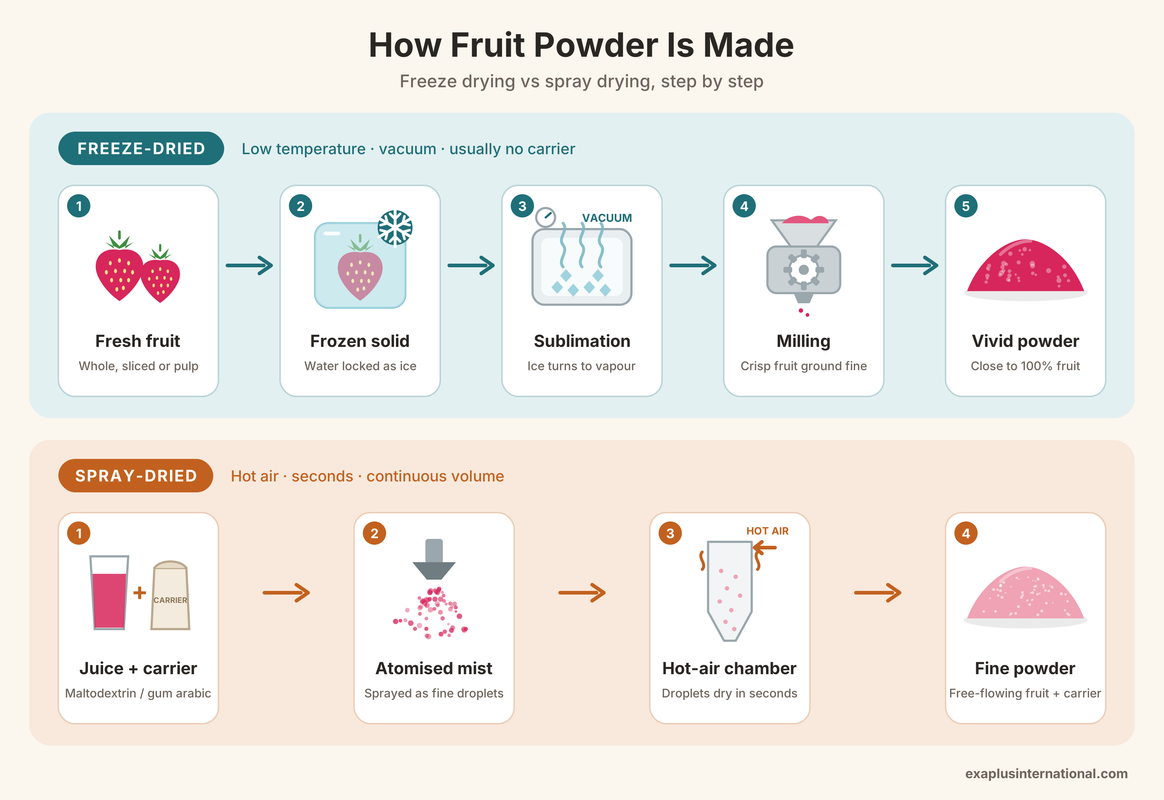
The process is fast, continuous and built for volume. The trade-off is that some aroma and heat-sensitive nutrients are lost, and the finished powder is part fruit, part carrier.
Freeze Dried vs Spray Dried: Side-by-Side
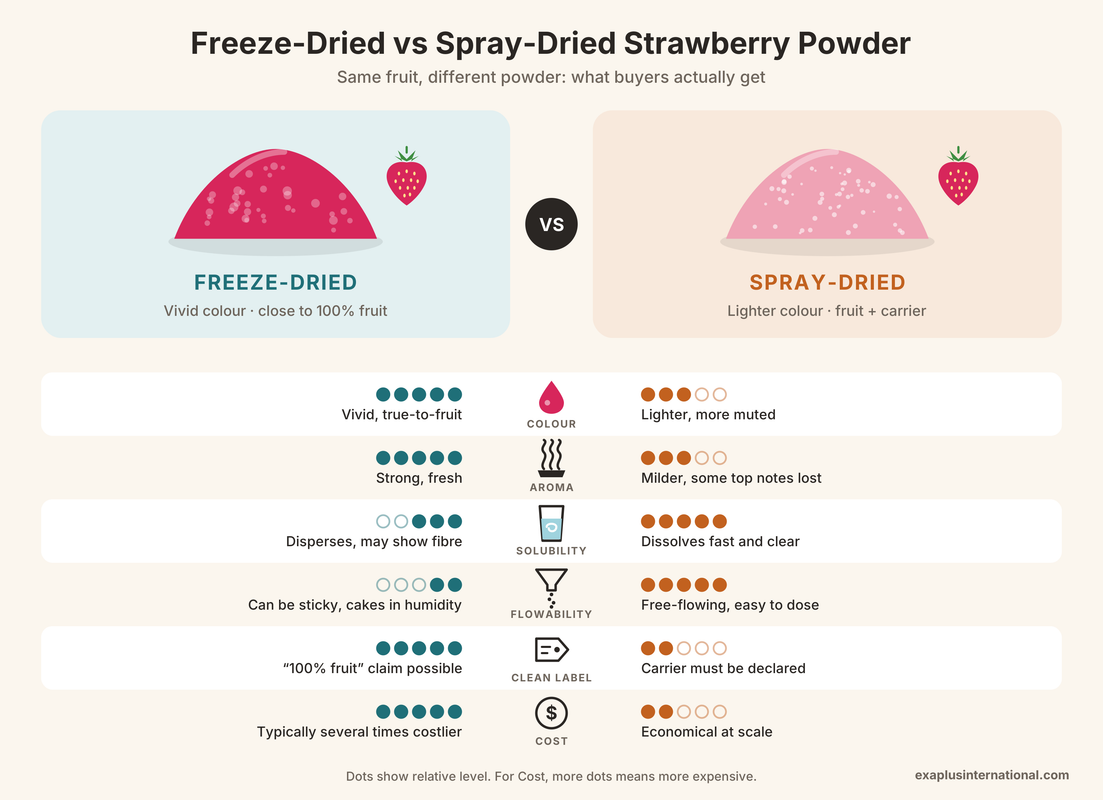
| Factor | Freeze-Dried Fruit Powder | Spray-Dried Fruit Powder |
| Fruit content | Often close to 100% fruit | Fruit solids blended with a carrier; ratio varies by supplier |
| Colour | Vivid, close to fresh fruit | Lighter, more muted |
| Aroma and flavour | Strong, fresh, true-to-fruit | Milder; some top notes lost to heat |
| Nutrient retention | High, including heat-sensitive vitamins such as vitamin C | Moderate; some heat loss |
| Solubility | Disperses well but may leave fine fruit fibre | Excellent; dissolves fast and clear |
| Flowability | Can be sticky; may need anti-caking care | Free-flowing, easy to dose |
| Moisture sensitivity | Highly hygroscopic (pulls moisture from air) and prone to caking | Less sensitive, though still needs dry storage |
| Bulk density | Low (light and fluffy) | Higher and more uniform |
| Shelf life and packaging | Good if sealed; needs strong moisture-barrier packing | Good with standard lined packing |
| Clean label | Strong: “100% fruit” or “no additives” claims possible | Carrier must appear on the label |
| Relative cost | Typically several times costlier | Economical at scale |
Buy Freeze-Dried Fruit Powder When…
- Your product is premium or clean-label. The brand promise depends on simple, short ingredient lists.
- You want to claim “100% fruit” or “no added carrier”. Freeze-dried powder is usually the only realistic way to make that claim with a powder.
- True colour and aroma are the selling point. Think of the bright pink of strawberry or the deep purple of blueberry in a finished product.
- Nutrition is part of the story. Superfood blends, amla vitamin C products and nutrient-led supplements benefit from low-heat processing.
- You use small doses for big impact. When a few grams flavour or colour a whole serving, the higher price per kilo matters less per unit.
- Texture and real fruit character matter. Inclusions, dustings and coatings look and taste more like real fruit.
Buy Spray-Dried Fruit Powder When…
- Your product is cost-sensitive and high-volume. Mass-market drink mixes and premixes need a predictable, affordable cost per serving.
- The drink must dissolve fast and clear. Instant beverages, sachets and vending mixes need powder that disappears in water or milk.
- You run automated filling or blending lines. Free-flowing powder doses cleanly and causes fewer stoppages.
- You need consistency across large batches. Spray drying delivers uniform particle size and colour lot after lot.
- A carrier on the label is acceptable. If your consumers and your market are fine with maltodextrin or gum arabic on the pack, you gain big savings.
- Flavour is supporting, not starring. When fruit is one note among several, spray-dried powder does the job well.
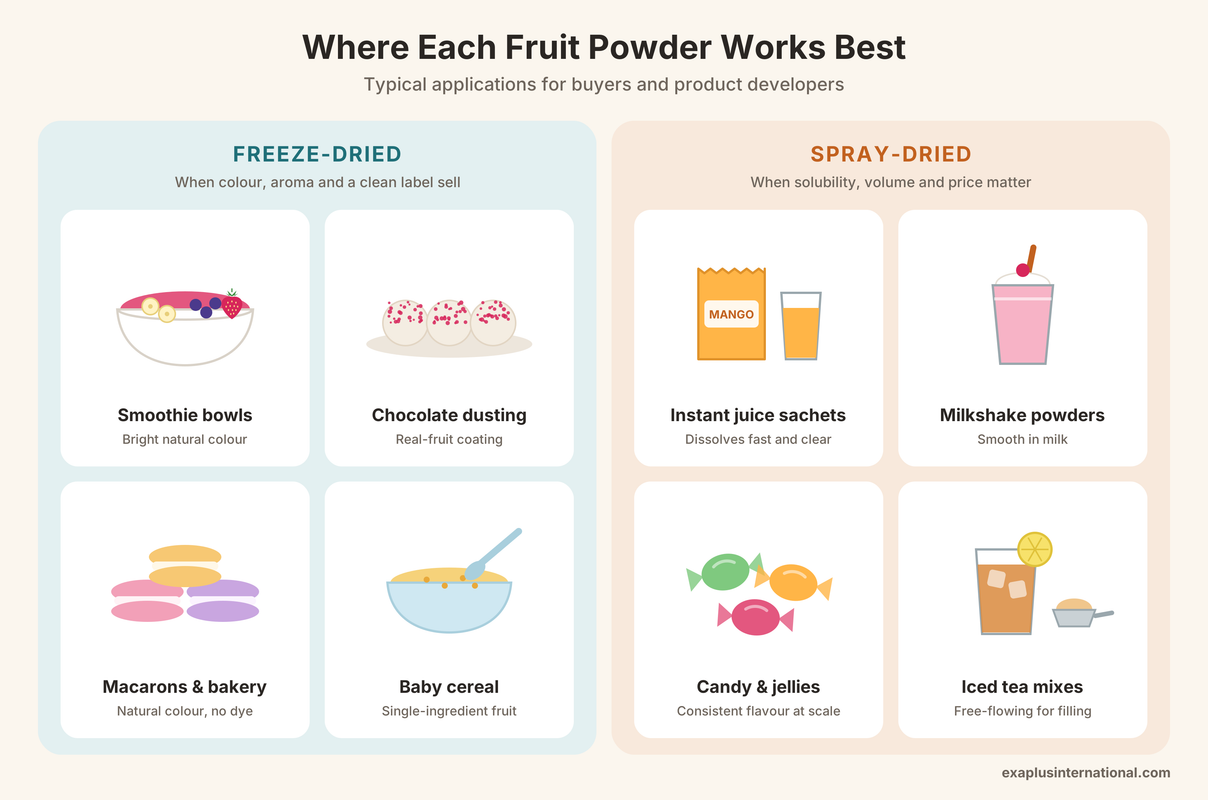
Applications of Freeze-Dried Fruit Powder
| Application | Example product |
| Smoothies and smoothie bowls | Freeze-dried strawberry or dragon fruit powder for a vivid pink bowl base |
| Premium nutrition and superfood blends | Blueberry and pomegranate powder in an antioxidant superfood mix |
| Supplements and capsules | Amla powder in vitamin C capsules or tablets |
| Baby food | Single-ingredient banana or mango powder for infant cereals |
| Yogurt and ice-cream inclusions | Strawberry powder swirled into Greek yogurt or gelato |
| Chocolate and confectionery coatings | Raspberry or strawberry dusting on white chocolate truffles |
| Natural colour in bakery | Beetroot or dragon fruit powder colouring macarons, frostings and cake sponge |
| Cereals and granola | Fruit-coated granola clusters with a real-fruit taste |
| Cosmetics and skincare | Pomegranate or papaya powder in face masks and scrubs |
| Gourmet and HORECA use | Mango powder rims on cocktails, plate dustings and pastry finishes in cafés and hotels |
Applications of Spray-Dried Fruit Powder
| Application | Example product |
| Instant drink and juice premixes | Spray-dried mango or orange powder in instant juice sachets |
| Flavoured milk and dairy beverages | Banana or strawberry milkshake powder |
| Sports and energy drink mixes | Pineapple or lemon powder in electrolyte drink blends |
| Bakery premixes | Fruit-flavoured cake, muffin and cookie premixes |
| Confectionery and candy | Guava or mango powder in hard candy, jellies and chewables |
| Ice-cream mixes | Fruit powder in soft-serve and ice-cream premix bases |
| Soups, sauces and seasonings | Tomato or tamarind-style fruit notes in seasonings, chutneys and snack coatings |
| Tea and coffee flavour blends | Peach or berry powder in iced tea premixes |
| Nutraceutical sachets and effervescent tablets | Fruit powder as the flavour base in vitamin sachets and fizzy tablets |
Quick Decision Guide
| If your product is… | Choose |
| A “100% fruit” smoothie powder | Freeze-dried |
| A mass-market instant juice sachet | Spray-dried |
| A clean-label baby food | Freeze-dried |
| A flavoured milkshake premix | Spray-dried |
| A premium chocolate or confectionery coating | Freeze-dried |
| A high-speed automated sachet filling line | Spray-dried |
| A superfood or vitamin C supplement | Freeze-dried |
| A sports or electrolyte drink mix | Spray-dried |
| A naturally coloured bakery product | Freeze-dried |
| A bakery or ice-cream premix sold on price | Spray-dried |
Some brands use both: freeze-dried powder where it shows (topping, colour, label claim) and spray-dried powder inside the base mix. This hybrid approach often gives the best balance of quality and cost.
Common Mistakes to Avoid
Paying freeze-dried prices for a beverage premix. If the powder is dissolved into a flavoured drink with sugar and other flavours, consumers rarely taste the difference. Spray-dried often delivers the same result at a fraction of the cost.
Using spray-dried powder where a “100% fruit” claim is needed. The carrier must appear on the label. If your brand promise is pure fruit, this is a compliance risk, not just a quality issue.
Ignoring hygroscopicity and caking. Freeze-dried powders pull moisture from humid air quickly. Poor packing or open bags in a humid plant can turn free powder into hard lumps within days.Skipping the COA review. A Certificate of Analysis (COA) lists the tested values for a specific lot. Always compare it against your specification before the shipment leaves the origin, not after it arrives.
Frequently Asked Questions
What is the difference between freeze dried and spray dried fruit powder?
Freeze-dried powder is made by freezing fruit and removing the ice under vacuum, so it is usually close to 100% fruit with strong colour and flavour. Spray-dried powder is made by spraying fruit juice mixed with a carrier into hot air, which gives a cheaper, free-flowing, fast-dissolving powder.
Is freeze dried fruit powder healthier than spray dried?
Freeze-dried powder generally keeps more heat-sensitive nutrients, such as vitamin C, because it is dried at low temperature and has no carrier diluting the fruit. Spray-dried powder still offers fruit flavour and some nutrition, but in a less concentrated form.
Why does spray dried fruit powder contain maltodextrin?
Fruit sugars are sticky and stick to the hot dryer walls. Maltodextrin or gum arabic acts as a drying aid that lets the fruit form a stable, free-flowing powder.
Which fruit powder is best for beverages?
For instant drinks, juice premixes and sachets, spray-dried fruit powder is usually the better choice because it dissolves quickly and costs less per serving. Freeze-dried powder suits premium smoothies and “100% fruit” drinks.
Why is freeze dried fruit powder so expensive?
Freeze drying is slow, energy-intensive and runs in batches, and it uses only fruit with no low-cost carrier. That is why freeze-dried powder is typically several times costlier than spray-dried powder.
How should fruit powder be stored?
Store it sealed in moisture-barrier packaging, in a cool, dry place, away from humidity and direct sunlight. Reseal opened bags immediately, especially freeze-dried powder.
Source the Right Fruit Powder for Your Product
The right choice is not “better” or “cheaper”. It is the powder that fits your product, your label and your margin. Start with your application and your label claim, then choose the drying method.
Exaplus International supplies freeze-dried, spray-dried and dehydrated fruit and vegetable powders from India through partner processing units, for importers, distributors, food manufacturers and private-label brands worldwide. We operate under FSSAI, APEDA and Spices Board exporter registrations, with GMP, HACCP and USFDA-registered. Private-label and OEM packing with customised packaging are available.
Request samples, full specifications and lot-wise lab reports: write to info@exaplusinternational.com or visit exaplusinternational.com. Tell us your application, and we’ll recommend the powder that fits it.