


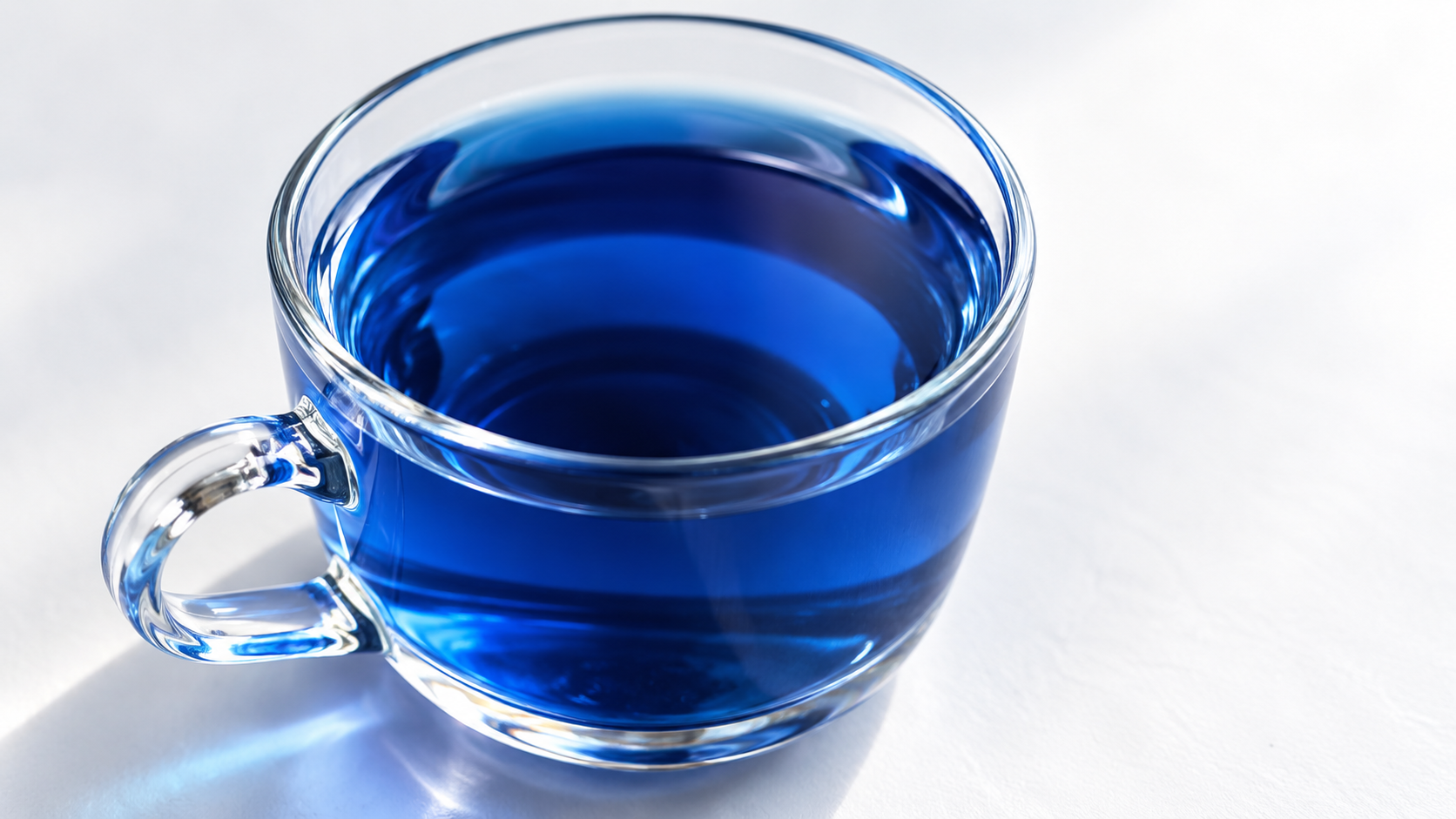
Blue tea sells for a reason that has little to do with flavour. In a category where almost every product looks the same once it is brewed, a clear sapphire cup is instantly identifiable. That visual difference is what moves it off a shelf, onto a menu, and into a formulation brief.
It is also what makes blue tea easy to buy badly. Colour can be faked. Colour can fade in a container. And the term “blue tea” is used loosely for two different products with different labelling and different caffeine profiles.
This article is written for buyers: private-label brands, importers and distributors, bulk ingredient buyers, and hospitality operators. It covers what blue tea actually is, why it changes colour, what separates a good hand-rolled pearl from a poor one, and the documents you should ask for before you commit to a lot. Exaplus International Pvt. Ltd. is a blue tea supplier and butterfly pea flower tea exporter based in Gurgaon, India, and the evaluation standards below are the ones we expect our own lots to meet.
What blue tea actually is?
“Blue tea” is a market term, not a botanical one. It refers to infusions made with the flower of *Clitoria ternatea* — the butterfly pea, a climbing vine in the legume family (the same plant family as beans and peas). It is not *Camellia sinensis*, the plant that produces green, black, white and oolong tea.
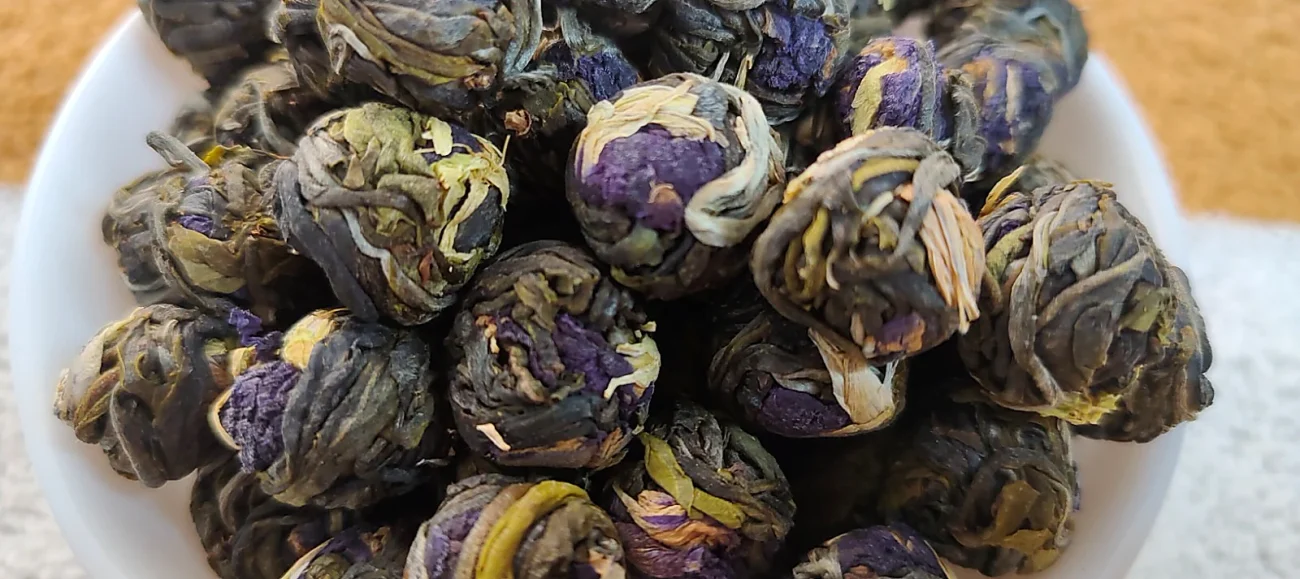
That distinction is commercially important, because two different products sit under the same name:
Pure butterfly pea flower A herbal infusion, or tisane. It contains no tea leaf and therefore no caffeine and no tea catechins (the polyphenol compounds characteristic of green tea). In most markets it must be labelled as a herbal infusion rather than as tea.
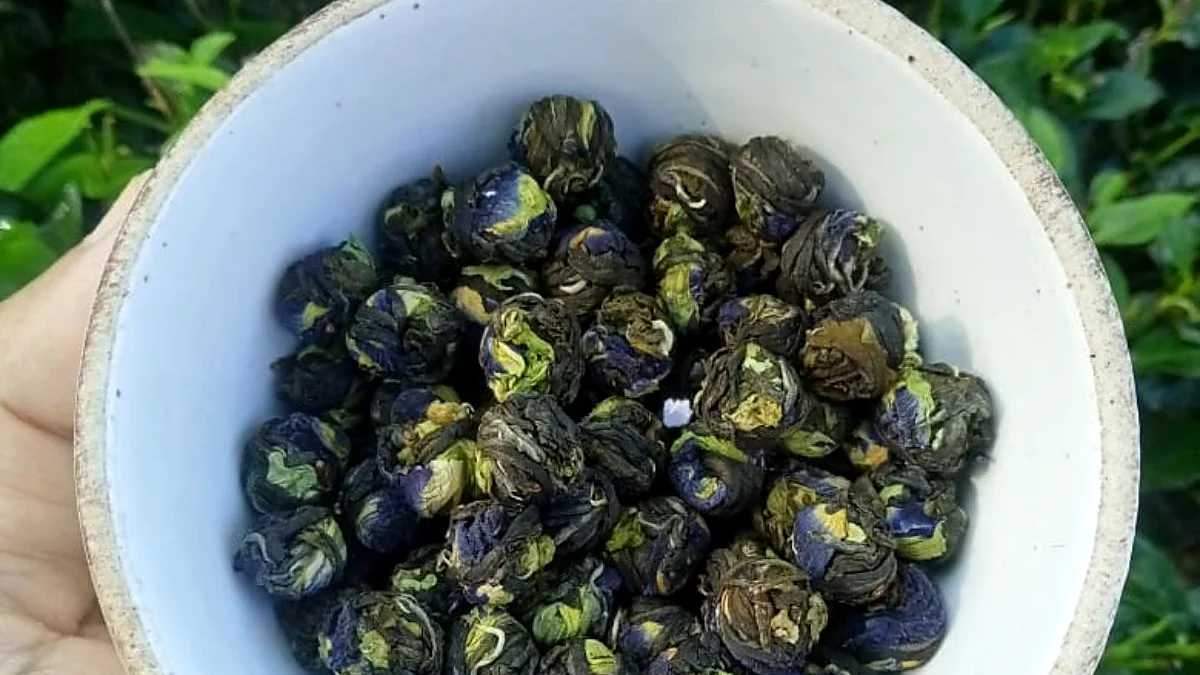
Blended blue tea, including our hand-rolled pearls These combine butterfly pea petals with whole-leaf green tea. The result carries genuine tea character, caffeine, and catechins, alongside the blue colour. It is a true tea product, and it is labelled and positioned differently.
Neither is better. They serve different buyers. But treating them as interchangeable causes real problems downstream: caffeine declarations, “caffeine-free” claims, ingredient statements, and the basic question of whether the word “tea” may legally appear on the front of your pack. Confirm this against your own destination market before you finalise artwork and specify clearly which of the two you are ordering.
The colour, explained properly
The blue comes from anthocyanins — a family of water-soluble plant pigments. Butterfly pea contains an unusually stable sub-group of these called ternatins, which is why the flower produces a blue infusion at all, when most anthocyanin-rich plants give red or purple.
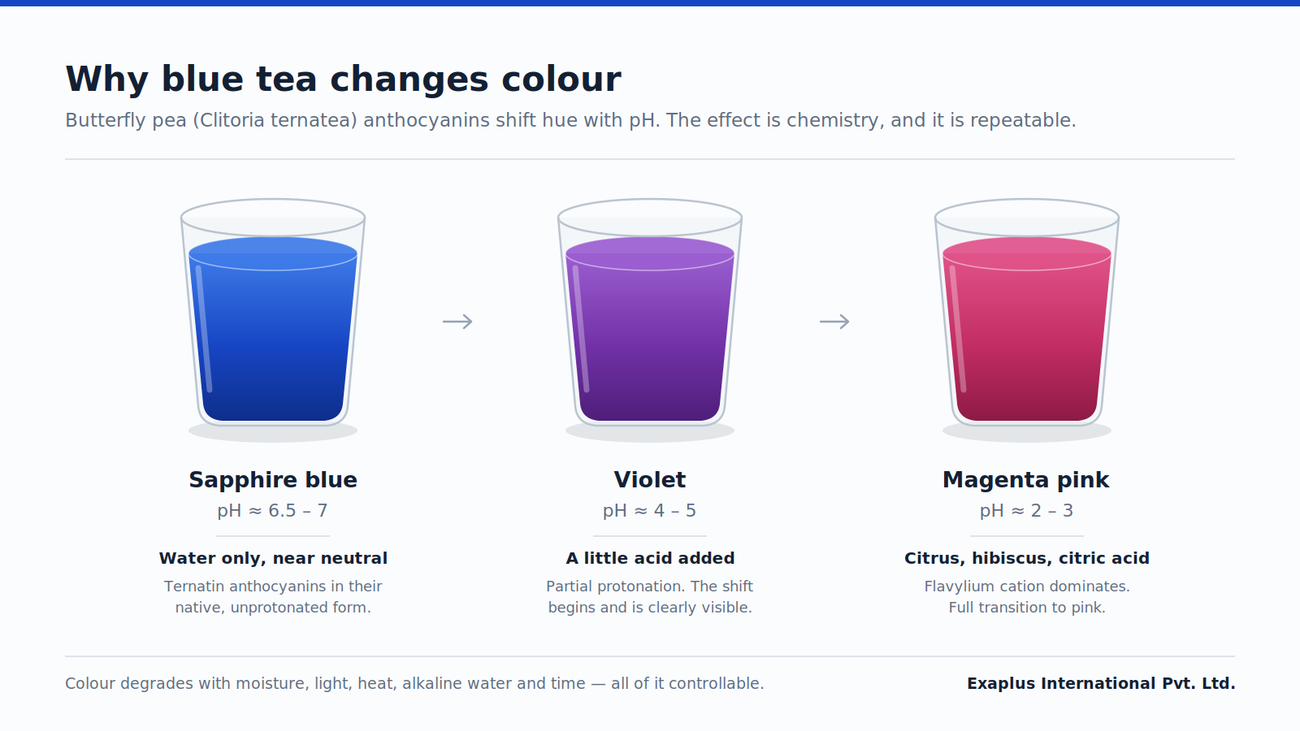
Anthocyanins change colour with pH, which is the measure of how acidic or alkaline a liquid is. Near neutral pH, the infusion reads blue. Add an acid — lemon, lime, hibiscus, citric acid — and the pigment structure shifts, moving the cup through violet to pink. This is chemistry, not a trick. It is repeatable, and it is the single most demonstrable feature of the product at the point of sale.
For a buyer, the more useful question is what destroys the colour. Anthocyanins are stable within limits, and outside those limits they degrade:
– Moisture: The most common cause of colour loss in storage. Petals that pick up humidity dull and brown.
– Light: Prolonged exposure, particularly in clear packaging, bleaches the pigment.
– Heat abuse: Sustained high temperature during drying, processing or transit degrades anthocyanins. Brewing water that is too hot also flattens the hue.
– Alkaline water: Hard, high-pH water pushes the infusion towards green-grey. This is worth testing with water from your own market, not only with the water at origin.
– Time and oxidation: Colour intensity declines slowly across shelf life even under good conditions.
Every one of these is a quality-control variable, not a marketing detail. If a supplier cannot discuss moisture specification, barrier packaging and drying temperature with you, they are unlikely to be controlling the colour you are actually buying.
Red flags
– Colour that is unnaturally uniform, neon, or identical across every petal
– Blends padded with stem, spent leaf or previously infused material
– Pearls that disintegrate instead of unfurling
– Moisture above specification on the certificate of analysis
– Colour that is visibly duller in the pre-shipment sample than in the original offer sample — always compare the two side by side and always ask for a retained reference sample.